Sunday, July 18, 2010

Tôi không hiểu

My grasp of the Vietnamese language crawls along.  A new word gained here and there.  The only time I get to practice my new vocabulary is when I casually show off to my Viet mother-in-law.  And she is dumbfounded that a white girl can even wrap her tongue around the sacred language.  The bottom line is that I can exist in my every day life without knowing Vietnamese.  Curse or blessing?

My fiance's mom grew up in Vietnam speaking her native tongue and learning French. Then the war came, beginning the scariest journey of her life.  The following years found her thrown from boat to prison to boat to prison, and finally to refugee camp.  Her journey culminated when she boarded a plane bound for the United States of America.  And then her second journey began.

She landed on American soil with two children and no English.  I can't even imagine; absolutely no English.  I asked her, on our most recent visit, "How did you survive? How could you get a job!?"  She weaved together for me a picture of their early existence: living off welfare, living off her husband's wages delivering pizzas, opening an Asian gift shop, pushing the kids through American public school, watching as their knowledge of English far surpassed her own, getting the chance to go to cosmetology school, working for and then running a hair and nail salon, and always the struggle, struggle, struggle.

The struggles of learning English were thrown on top of the financial troubles.  There were not many Viets in the country back then, so Viet-English translations were limited.  She was reduced to looking at picture books labeled ONLY in English and attending a class for immigrants where the teacher ONLY spoke English.  She would see a picture of a glass of water with a word next to it, but she would think, "Does that word mean "water" or "glass"?  Or perhaps it means "drink" or even "to drink"?"  Another tale she tells me is seeing the word "table," but thinking it is said like the french word, "table." Same spelling.  Same meaning.  Different pronunciation.

As she tells me these stories last weekend, she expresses the difficulty, what she deemed impossibility at times.  But she kept coming back to one phrase: "For my children."  All the trials in her life can be captured in those three little words.  She escaped oppression, battled poverty, and learned a language and culture from scratch.  And all so her children would know life, liberty, and the pursuit of happiness.  One of those kids grew up to be the man I love.  How can you thank someone for that??  The only way I know is to sit, eyes wide, and listen to her stories.

Saturday, July 10, 2010

Viet'd Up with Gỏi Cuốn

Viet: gỏi cuốn
English: spring roll
Pronunciation: yoi (like a question) coon (rising)

A weekend in Vietnam (aka Thai's mom's house) always Viets me up a bit.  I was already thrilled when his mom set out all the ingredients to make fresh shrimp spring rolls, but then she said that she would show ME how to make them.  Me! Người mỹ trắng!  So here is a 100% legit Viet recipe, from the mouth of a woman raised on the Southern tip of Vietnam:
  1. First, moisten the bánh tráng (round sheets of rice paper).
  2. Lay the sheet flat on a plate. 
  3. On the closest part of the sheet to you, put a small amount of fresh lettuce, cilantro leaves, cooked (not hot) rice noodles, and four or five shrimp (or meat of choice).
  4. Then, fold in the right and left sides of the bánh tráng to keep the ingredients from falling out the sides.
  5. Keeping the sides held in, wrap the closest part of the bánh tráng over the ingredients very tightly.
  6. Roll tightly.
NOTE: The gỏi cuốn will taste 10 times better if you are wearing purple pajamas brought from Vietnam a month ago, size XL.

It is also wonderful to have Thai's mom as my Vietnamese Consultant.  Instead of spending 10 minutes surfing the net and piecing together a shaky pronunciation, I simply turn around and say into the kitchen, "How do you spell trắng?"  That leads to a 10 minute explanation of that word and 5 related phrases, each spelled out and repeated several times.  The Viet newspaper next to me is covered in handwritten Vietnamese words.  I find it quite enjoyable!

Monday, July 5, 2010

First attempts at Viet cooking

I decided to make my first dive into Viet cooking.  I found two recipes online that claimed to be Vietnamese.  This is their story.

Viet Food Attempt #1

Original Recipe: Vietnamese Salt and Pepper Eggplant
Source: RecipeZaar.com
Evolved Into: Might-Be-Viet Ginger & Pepper Eggplant Fries

Viet: cà tím
English: Eggplant
Pronunciation: gah (low) theme (rising)

Pronunciation Confusion:  Forward accent indicates a high, rising tone. Cá means fish. Tím means purple.  Backward accent indicates low sound. Cà is the first part of eggplant. Tìm mean search. 

Friday, June 18, 2010

người Mỹ

Viet: người Mỹ
Meaning: American person
Pronunciation: Blend the n and g in the back of the throat, then add (as the British would say) "oi!" in the gradually falling tone. Second word is "Me" as a sharp rising tone.

When I go into an Asian restaurant, I pretend that everyone there thinks I'm Asian.  It probably harkens back to the middle school desires to "blend in."  Inevitably, there are moments during my brush with the staff at these places of Asian cuisine when I might as well be wearing a sign that says, "I am a stupid white American that doesn't understand your language or your culture!"  At least, that's how I feel at these moments.

When Thai and I went to New York City, we ate in a delicious restaurant in Chinatown.  We had soup and duck (pre-vegetarianism for me) and amazing rice!  However, when our order was brought to our table, there was a very significant difference in the utensils we received.  Thai was blessed with chopsticks, while I was handed a fork.  That was the first time I sensed the giant sign across my chest: Stupid. White. American.  I was a bit embarrassed, which he did not understand.  I tried to explain; How would he feel if he went into a steakhouse, and the server brought chopsticks for him?  Of course, he said that would be hilarious.  He is quite impossible sometimes.

We often go out to Vietnamese restaurants with Thai's family.  The waitress will chatter in Vietnamese to Thai's sister, Thai will then sputter out his rehearsed pronunciation of the Viet dishes, and then the waitress will look at me.  She'll size me up and ask, in English, "And what would you like?"  I'll mumble, "Spring rolls and a side of rice, please," and she'll be on her way.  My self-illusion that I am Viet is shattered!  Now, occasionally, I will throw in some Viet words that I know.  Cảm ơn.  Thank you.  But I always mix up whether it's pronounced "come" or "cam," and thus I usually just end up with a confused glance and pitying nod.  Can I skip ahead to the language lessons about food?

Wednesday, May 26, 2010

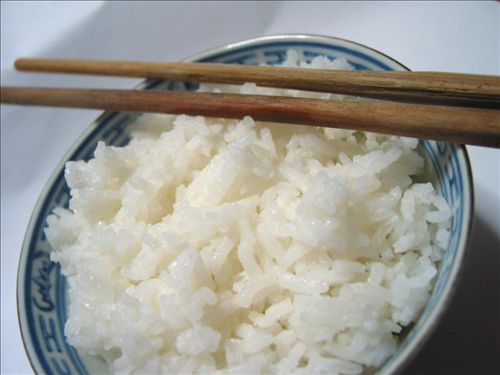
cơm

Viet: cơm
Meaning: cooked rice
Pronunciation: a mix between "gum" and "scum" minus s

The Asian staple.  I have eaten more rice in the last four and a half years then I think I ate in the whole eighteen years before I met my fiance.  He eats it with Chinese sausage, with canned tuna, with barbeque, with any meat he can dig out of our fridge.  And always drowned in Golden Mountain Seasoning Sauce, which I only recently realized is soy sauce (the Vietnamese literally translates to "salt to increase taste"). 

In the beginning, Thai always made the rice.  He'd scoop the dry grains out of the giant cloth bag in the pantry, and they'd clatter into the silver bowl of the rice cooker.  He'd casually hold the bowl under the faucet for a few seconds, before fitting in back in its nest.  And 20 minutes later, voila! Delicious white rice!  I was in awe of this magic machine that combined dry and wet with heat to create perfection.

Then, Thai graced me with the darkest and deepest Vietnamese secret to be passed down for generations... (do they even have rice cookers in Vietnam?)... The key was the amount of water.  Too little and the rice couldn't cook; too much and it turned into mush.  The perfect amount, he instructed me, was to the first knuckle of your pinky finger.  And thus I took my first step forward as a Viet chef.


------ Note: There are three versions of the letter O in the Viet alphabet.  Yes, three!!   Let's see if I get these right -- o is said like "aww," ơ is said like "uh," and ô is said like "oh." -- Now just throw in the accents and there are only seventeen possible combinations for the letter O!  Oh my...